
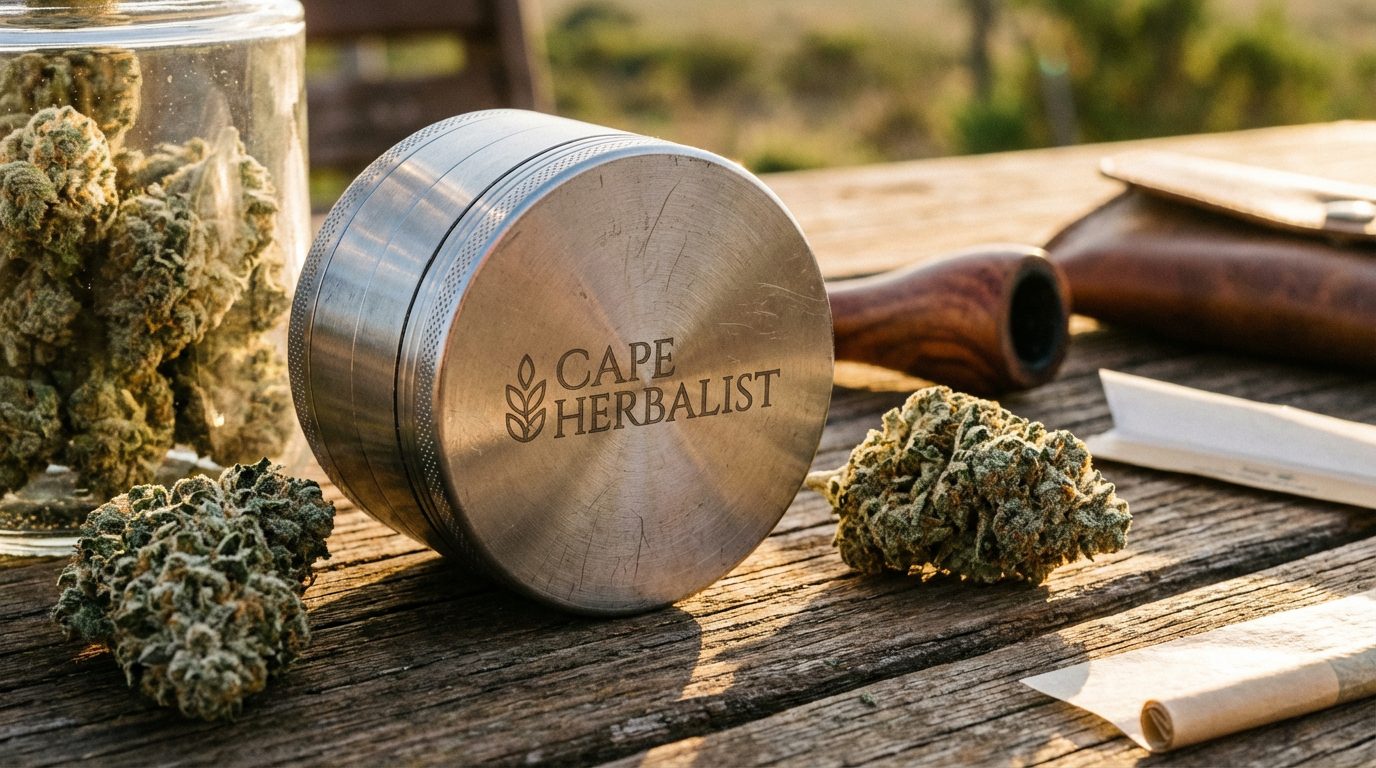
Let’s be honest for a second. You have spent the last few months acting like a helicopter parent to a set of leafy green children. You have obsessively checked the pH levels of your water, battled against the erratic nature of loadshedding to keep your light cycles consistent, and perhaps even played a little classical music to encourage vigorous growth. You have trimmed with the precision of a surgeon, cured your harvest in glass jars burped with religious punctuality, and finally, you hold in your hand the perfect, frost-covered nug. It is a masterpiece of horticulture. Ideally, this is the moment of triumph. But for far too many South African home growers, this is the exact moment they ruin everything. They take that pristine, terpene-rich flower and shove it into a cheap, jagged-toothed grinder that mashes it into a sad, sticky pulp.
It is a tragedy of Shakespearean proportions. After all that effort, destroying the structural integrity of your bud in the final seconds before consumption is heartbreaking. We need to talk about why standard grinders are the enemies of quality cannabis, and why the method you use to break down your herb matters just as much as the nutrients you fed it. If you are serious about your homegrown cannabis, it is time to stop crushing your harvest and start treating it with the respect it deserves.
The Anatomy of a Trichome (And Why You Keep Breaking Them)
To understand why your average plastic or cheap metal grinder is a villain in this story, we have to zoom in on what we are actually trying to harvest: the trichome. These microscopic, mushroom-shaped glands are the powerhouse of the cannabis plant. They are where the cannabinoids (like THC and CBD) and the terpenes (the essential oils responsible for aroma and flavour) live. Think of a trichome as a tiny, extremely fragile glass balloon filled with precious oil. When that balloon is intact, the contents are preserved, potent, and aromatic. When it ruptures, those volatile oils begin to degrade immediately upon contact with air and light.
When you look at your bud and it looks like it has been dusted with sugar or frost, you are looking at thousands of these trichomes. They are the reason you grew the plant in the first place. Now, consider the mechanics of a traditional \u201ctoothed\u201d grinder. These devices work on the principle of shear force and friction. You place the flower between two sets of metal or plastic teeth and twist. The teeth do not slice; they tear. They rip the plant matter apart through brute force. In the process, those delicate trichome heads are smashed against the side of the grinder, crushed between the teeth, or smeared across the bottom of the chamber.
That sticky residue that gums up your grinder after a week of use? That isn\u2019t just \u201cplant glue.\u201d That is the soul of your cannabis. It is the potency and the flavour profile that should have been in your joint or vaporiser, but is instead caked onto the walls of a cheap accessory. By mashing your bud, you are essentially wringing out the sponge before you even get to use it.
The Myth of the “Fine Grind”
There is a pervasive myth in the cannabis community that a powdery, dust-like grind is superior. While a fine grind can be useful for certain vaporisers that rely on conduction heating, for the vast majority of smokers and connoisseurs, a powdery grind is detrimental. When you pulverise your flower into dust, you dramatically increase the surface area. While this might sound good in theory, in practice, it leads to a harsh, hot smoke. The increased surface area means the material burns too hot and too fast, scorching the terpenes before you can taste them.
Furthermore, a mashed, powdery consistency restricts airflow. If you have ever rolled a joint that felt like trying to suck a golf ball through a garden hose, it was likely because the weed was ground too fine and packed too tight, clogging the airflow channels. A proper consistency should be fluffy, airy, and uniform. It should look like it was gently pulled apart by hand, maintaining the integrity of the calyxes while creating enough separation for heat to travel through evenly. This is the texture that allows for a slow, even burn and a smooth, flavourful draw.
The Aluminium Problem
Beyond the destruction of trichomes, there is a material concern with standard grinders. Many mid-range grinders available at tobacconists are made from anodised aluminium. While lightweight, aluminium is a soft metal. Over time, the constant friction of teeth grinding against teeth causes micro-abrasions. If you have ever noticed that your grinder turns slightly strangely or the threads feel gritty, you might be dealing with metal shavings. The last thing you want to add to your organic, pesticide-free homegrown harvest is microscopic aluminium dust.
Cheap plastic grinders are even worse. Not only can plastic chips break off into your mix, but the static electricity generated by plastic acts like a magnet for trichomes. The kief sticks to the plastic walls rather than staying on the plant matter, robbing you of the potency you worked so hard to cultivate. You need a tool made from materials that are harder than the plant but inert enough not to contaminate it.
Milling vs. Grinding: A Paradigm Shift
This is where the distinction between “grinding” and “milling” becomes crucial. In the culinary world, you wouldn’t use a hammer to chop basil; you would use a sharp knife to slice it, preserving the oils. The same logic applies here. Milling is a process that gently crumbles the flower along its natural breaking points, rather than forcing it through a sieve of spikes. It separates the stem from the flower and fluffs up the material, resulting in a product that is voluminous and intact.
The difference in the end product is visually striking. Milled cannabis looks lighter, greener, and more vibrant. It feels softer to the touch. Because the trichomes are still attached to the plant material rather than smeared on the tool, the aroma is significantly more pungent immediately after milling. This method respects the biological structure of the flower.
The Professional Solution for Home Growers
So, if the cheap plastic puck and the jagged metal teeth are out, what is the alternative? You need a device engineered specifically to crumble, not crush. This is where innovation in cannabis accessories has finally caught up with the sophistication of modern cultivation. We are moving away from the primitive tools of the past and embracing precision engineering. If you are looking for the absolute pinnacle of this technology, the Flower Mill, Next Gen Premium, 2.5 Stainless steel is the instrument that will change your ritual forever.
Unlike traditional grinders that use teeth to shear the herb, the Flower Mill utilises a rotor system. It gently rolls the herb across a screen, causing it to naturally crumble where it wants to break apart. There are no teeth to clog up, and no spikes to smash the trichomes. The result is a fluffy, consistent texture that is perfect for rolling or packing bowls. Because it is made from food-grade stainless steel, you eliminate the worry of aluminium dust or plastic static. It is a heavy, durable piece of kit that feels like a serious tool rather than a toy.
The beauty of the Flower Mill, Next Gen Premium, 2.5 Stainless steel lies in its ability to process larger quantities without jamming. We have all been there\u2014trying to force a dense, sticky nug into a grinder and having it lock up, requiring a wrestling match to get it to turn. Because the milling action is progressive, it handles dense homegrown buds with ease. It separates the stiff stems from the usable flower, leaving you with a pile of perfectly prepared cannabis that burns evenly and tastes exactly how it smells on the plant.
Terpenes and the Entourage Effect
Why does this matter so much? It comes down to the \u201cEntourage Effect.\u201d This is the theory that cannabis works best when all its compounds\u2014cannabinoids, terpenes, and flavonoids\u201—are consumed together. When you smash your bud in a bad grinder, you are altering that ratio. You are losing a significant percentage of the volatile terpenes to the grinder\u2019s teeth. This doesn’t just change the taste; it changes the effect. A strain that is supposed to be uplifting and citrusy might feel dull and heavy if the Limonene terpenes have been destroyed by heat and friction during grinding.
By using a mill, you preserve the full spectrum of the plant. You get the high that nature intended. For home growers who have selected specific genetics for their unique effects, preserving this profile is the whole point of the exercise. You didn’t grow \u201cgeneric weed\u201d; you grew a specific cultivar. Don’t turn it into generic dust at the last hurdle.
The Ritual of Preparation
There is also something to be said for the ritual of it all. Growing cannabis is a slow, meditative process. It teaches patience. Consuming it should be no different. Using a premium tool adds a level of satisfaction to the experience. The tactile feel of stainless steel, the smooth rotation of the rotor, and the sight of perfectly fluffed flower falling into the catch basin-it elevates the session. It signals to your brain that this is something to be savoured, not just consumed.
Think of it like decanting a fine wine. You could drink it straight from the bottle, but allowing it to breathe opens up the character of the vintage. Milling your bud allows it to breathe. It creates the optimal surface area for combustion or vaporisation without sacrificing the essential oils. It turns the act of rolling a joint into a craft.
Investing in Longevity
We often hesitate to spend money on accessories, even after spending thousands on grow lights, tents, nutrients, and seeds. It is a strange psychological block. We will buy the best genetics, but skimp on the one tool we use every single time we smoke. However, a high-quality stainless steel mill is a buy it for life purchase. Unlike aluminium grinders that dull and chip, or plastic ones that crack, a stainless steel mill is virtually indestructible. It is easy to clean, stays sharp, and maintains its performance year after year.
When you calculate the cost over the years of use and the value of the cannabis you are saving by not mashing it into the walls of a cheap grinder—the investment makes perfect sense. It is an investment in quality of life and quality of smoke.
Conclusion: Respect the Flower
South Africa’s cannabis culture is evolving rapidly. We are moving past the days of slope-grown mystery bags into an era of world-class home cultivation. As our growing skills improve, our tools need to keep pace. You cannot expect top-shelf results if you are using bottom-shelf processing methods. The logic is simple: if you respect the plant enough to grow it with care, you should respect it enough to grind it with care.
Stop crushing your harvest. Stop smearing your hard-earned trichomes onto dull metal teeth. Stop settling for a harsh, uneven smoke. Upgrade your approach and switch to milling. Your palate, your lungs, and your plants will thank you. It is time to experience your homegrown bud exactly as it was meant to be—flavourful, potent, and perfectly prepared.
Keywords: Homegrown Cannabis, Cannabis Processing, Terpene Preservation, Flower Mill, Cannabis Accessories